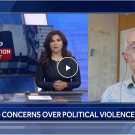
There are growing concerns about political violence after the assassination attempt on former President Donald Trump in Pennsylvania.
In this interview with KCRA's Brittany Hope, Dr. Garen Wintemute shares the findings from annual surveys on support for and willingness to engage in political violence.
“Remember during the 2020 presidential race when Donald Trump refused to disown right-wing violent extremists, instead telling the Proud Boys to “stand back and stand by”? We might now know what they’ve been standing by for.” Continue reading.
Surveys have found concerningly high levels of agreement that the United States will experience civil war soon. This study assesses variation in expectation of and perceived need for civil war with respondent sociopolitical characteristics, beliefs, firearm ownership, and willingness to engage in political violence.
Abstract OBJECTIVEThis study investigates the association between replacement thinking, status threat perceptions, and the endorsement of political violence among non-Hispanic white adults in the United States.
In this issue: Research is at the forefront of what we do, and we are constantly looking for ways to share findings and inform the public. This past month, two VPRP faculty wrote about the implications of their research as they relate to current events. Both op-eds are on the short side, and we invite you to give them a read!
A 2022 survey in the USA found concerningly high prevalences of support for and personal willingness to engage in political violence, of beliefs associated with such violence, and of belief that civil war was likely in the near future. It is important to determine the durability of those findings.
How do firearm owners and nonowners in the United States differ in support for and willingness to engage in political violence, and how do these measures vary among subsets of firearm owners?
FINDINGS
In this survey study with 12 851 participants, firearm owners were only moderately more supportive of political violence than nonowners. Recent purchasers and owners who always or nearly always carried firearms in public were more supportive of and willing to engage in political violence than other subsets of firearm owners.
Identifying groups at increased risk for political violence can support prevention efforts. We determine whether “Make America Great Again” (MAGA) Republicans, as defined, are potentially such a group.
Respondents reported their views on 8 right-wing extremist groups and social movements: the Proud Boys, Oath Keepers, Three Percenters, white supremacy movement, militia movement, boogaloo movement, QAnon, and Christian nationalism.
Based on respondents’ answers for individual groups and movements, we created an aggregate measure of approval for all 8 taken together; 1.4% of respondents were classified as “strong approvers” on this measure.
As compared with non-approvers, strong approvers were far more likely to view political viole