


Public opinion on civil war in the USA as of mid-2024
Findings from a nationally representative survey
Quick Summary
- In mid-2024, the beliefs that “in the next few years, there will be civil war in the United States” and that “the United States needs a civil war to set things right” were uncommon.
- Many of those who expected to join the fighting if war broke out said they would change their minds if they were urged to do that by their families, friends, or respected community leaders.
About the Study
FINDINGS IN BRIEF
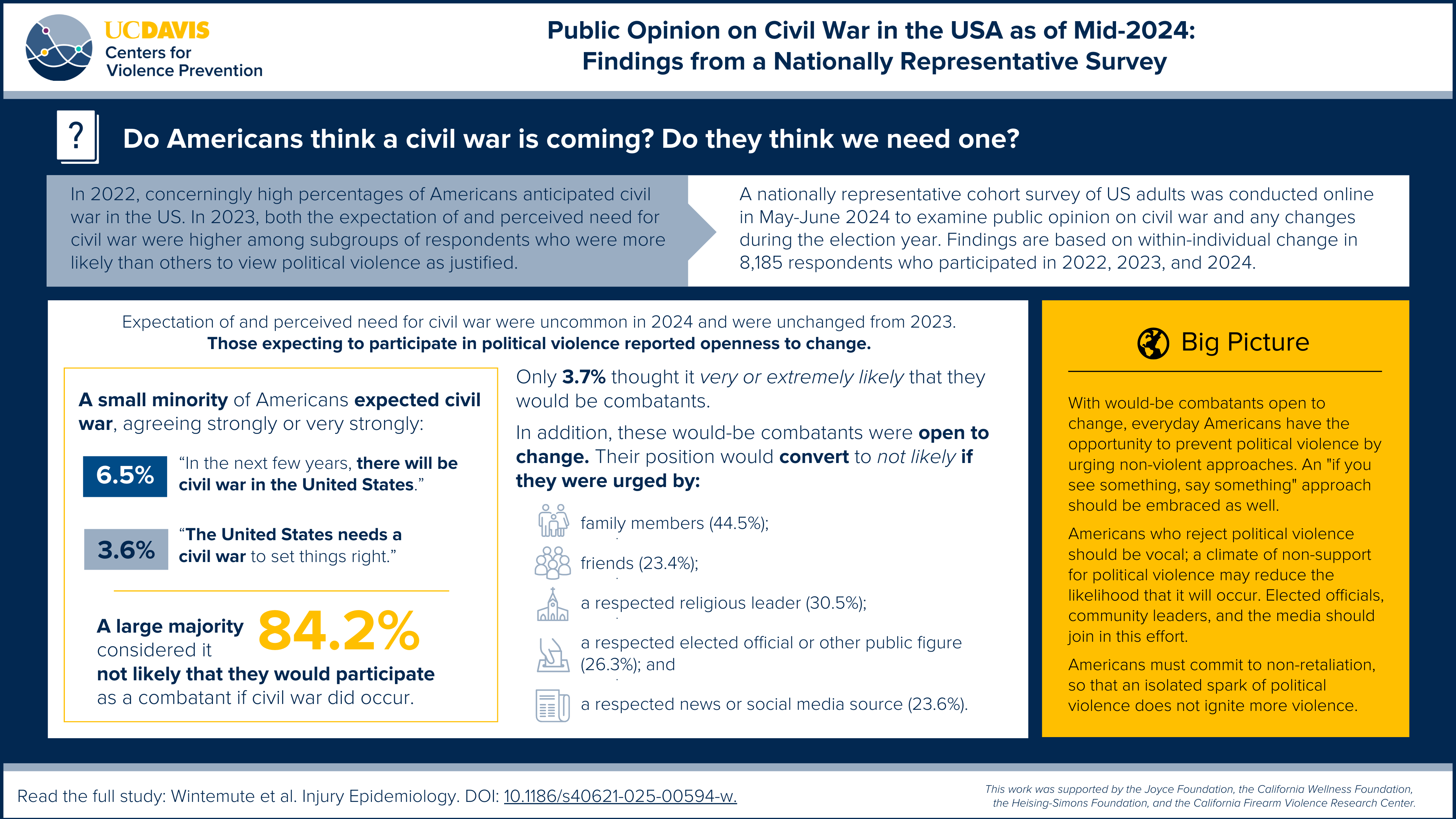
- Strong or very strong agreement that civil war was coming and that it was needed were both uncommon and did not increase from 2023 to 2024 (6.5% and 3.6%, respectively, in 2024; 5.7% and 3.8%, respectively, in 2023). This good news was counter to our expectation; 2024 was an election year and a time of increased political polarization.
- There was little support for large-scale political violence; 8.0% of respondents said they would support a right-wing insurgency, and 6.7% would support a left-wing insurgency.
- In the event of large-scale conflict, only 3.7% of respondents considered it very or extremely likely that they would participate as a combatant.
- Of those likely combatants, 44.5% reported that their position would convert to “not likely” if this were urged by family members, 30.5% if urged by a respected religious leader, and about 25% if urged by friends, a respected elected official or other public figure, or a respected news or social media source.
- This openness to change extended even to respondents who considered it very or extremely likely that, in a large-scale conflict, they would kill a combatant from the opposing side.
IMPLICATIONS AND CONCLUSIONS
These findings are generally good news. Support for and willingness to participate in large-scale political violence were uncommon and did not increase in 2024, an election year. Widespread public awareness of these findings could itself help prevent political violence from occurring.
The evidence from this study, and an extensive body of research on behavior change, suggest an intervention that could be implemented rapidly and would likely prove useful. The large majority of Americans who reject political violence need to make their opposition clear to family members, friends, and others in their social networks, with the expectation that this will be effective. Elected officials, community leaders, and the media should join in this effort.
Americans must also commit to non-retaliation, so that an isolated spark of political violence does not ignite a conflagration.
And as always, Americans should take to heart this recommendation: “If you see something, say something.” Many prevention measures depend on critical information about threatened violence getting to those in a position to do something about the threat.
METHODS
CVP has conducted a large, nationally representative survey on political violence each year since 2022. We collect data from the same individuals each year, so that we can accurately monitor trends. This survey was conducted online May 23 to June 14, 2024. Participants were members of the Ipsos KnowledgePanel. There were 8185 respondents for this analysis; the completion rate among those eligible to participate was 91.6%.
Citation
Wintemute GJ, Li Y, Wright MA, Crawford A, Tomsich EA. Public opinion on civil war in the USA as of mid-2024: findings from a nationally representative survey. Injury Epidemiology. 2025 Jul 3;12(1):36.
Learn More
- Read the study in Injury Epidemiology
- View the visual abstract for this study, also available in our visual abstract archive
- A preliminary version of this study was published September 15, 2024 on SocArXiv